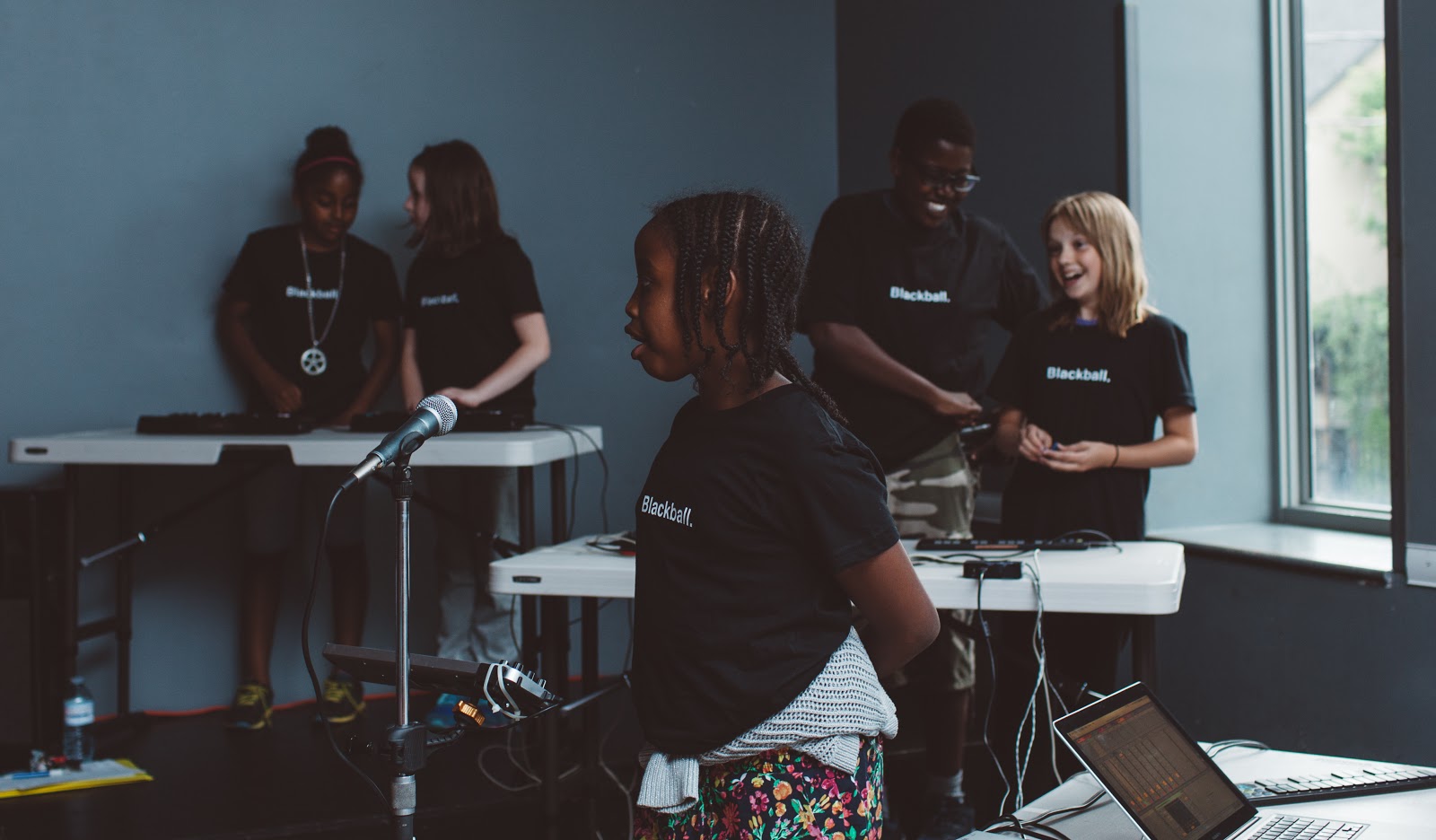
Our new video gets up close and personal with Blackball clients at TKBGC's TP Loblaw site in Toronto Trinity-Bellwoods.
Hear what they have to say.
Thanks go to Ella, Lucas, Rachel, Nevaeh, Stella, Allison and Madelyn for taking the words right out of our mouths.
Friday, October 19, 2018
Friday, October 12, 2018
Wednesday, June 13, 2018
Musical Chairs. Not.
One week from today, the Blackball performance group will debut new music on a new kind of instrument.

Meet the blackballophon, a MIDI controller we built out of spare robot parts, disused electric guitars and a blue chair.

We've used Arduino and Makey-Makey technology to create a musical control surface that provides beat-making and a good sit-down. Simultaneously.

Blackball.
You know.
Electronica.
For kids.

Blackball performs at 6:00 PM Wednesday 20 June at the Toronto Kiwanis Boys & Girls Clubs' annual general meeting at 20 Portugal Square.
Meet the blackballophon, a MIDI controller we built out of spare robot parts, disused electric guitars and a blue chair.
We've used Arduino and Makey-Makey technology to create a musical control surface that provides beat-making and a good sit-down. Simultaneously.
Blackball.
You know.
Electronica.
For kids.
Blackball performs at 6:00 PM Wednesday 20 June at the Toronto Kiwanis Boys & Girls Clubs' annual general meeting at 20 Portugal Square.
Sunday, May 6, 2018
No More Sheet Music. Ever.
Johnny say All Notes Off when you listen and learn to the No More Sheet Music demo: Click me, already.
Saturday, September 9, 2017
In October, we're taking control.
With less than a month to go before Blackball shatters the peace and quiet of Regent Park and Trinity-Bellwoods, Blackball kids are raring to take their places and get synthesized.

Who's the lucky Blackballista that gets to make medicine with this newly-acquired M-Audio Axiom 25 control surface? The one with semi-weighted keys and a real-time velocity display?
We'll talk.
In the meantime, you can watch this this live Blackball performance footage.

Who's the lucky Blackballista that gets to make medicine with this newly-acquired M-Audio Axiom 25 control surface? The one with semi-weighted keys and a real-time velocity display?
We'll talk.
In the meantime, you can watch this this live Blackball performance footage.
Saturday, December 17, 2016
Second Sight.
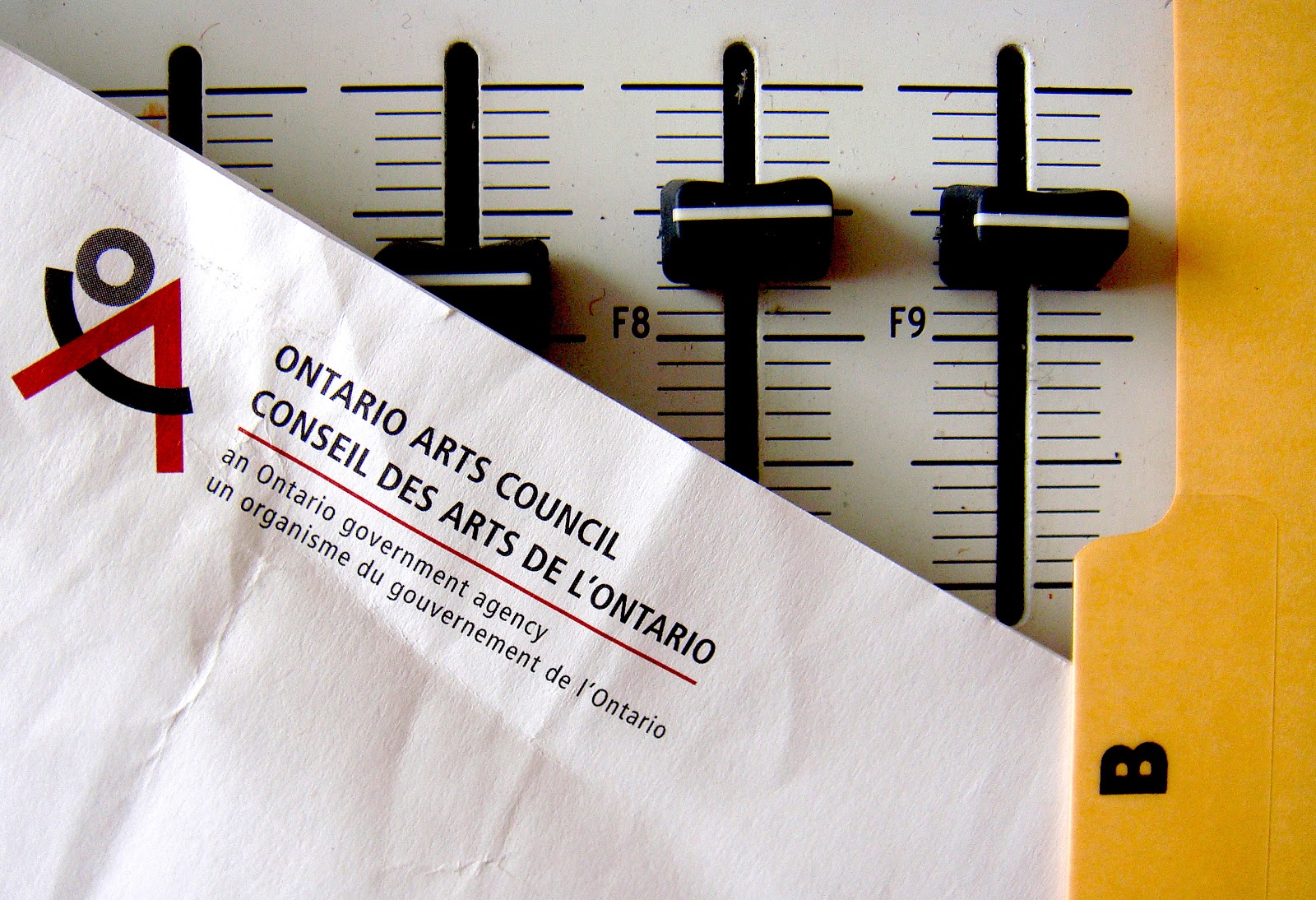
Thanks to the very generous support of the Ontario Arts Council, Blackball's long-awaited second site goes operational in the New Year.
With this much-needed contribution of a significant amount of moolah, Blackball will deliver its transformational electronic music performance and production program to not one, but two Toronto Kiwanis Boys And Girls Clubs locations, Regent Park and Trinity Bellwoods.
Is there space in your community for innovative electronic music programming? Blackball would love to partner with you.

It takes two, baby.
Friday, July 22, 2016
FW ii: Magnificent. Seven.
The fourth iteration of the Blackball electronic music project is underway at the Toronto Kiwanis Boys and Girls Club. 
As of this writing, seven kids
—a Blackball record—have signed on for the Fall/Winter term.
But there's more. Talks are underway with a TKBGC unit in the downtown Toronto area for a second, discrete Blackball site.
Watch this space for news, performance dates and exciting updates.
Photos by Simon Remark at ecstaticphotography.ca.
Sunday, June 5, 2016
Blackball: Alive and Pictured.
On the 15th of June, the young musicians of the Blackball Project's school-year session took the stage at the Toronto Kiwanis Boys & Girls Clubs AGM and ended the year with big beats and sweet synths.
Meanwhile, there's a new band waiting in the wings: Blackball's second summer session is already underway.
Every picture tells a story.
Photo credits, 1-7. Simon Remark at ecstaticphotography.ca, 8. Alexandra Hall.
Monday, May 9, 2016
Defined
We produced this short video to give the world at large a clue to the Blackball project is all about.
Won't you lend your ears and eyes to our fledgling project, and watch this rivetting "What-We-Do"?
The play length is all of 2:59.
That's 28 seconds less than the '45 radio edit of Kraftwerk's Autobahn. You can't go wrong.
See It Now.
Won't you lend your ears and eyes to our fledgling project, and watch this rivetting "What-We-Do"?
The play length is all of 2:59.
That's 28 seconds less than the '45 radio edit of Kraftwerk's Autobahn. You can't go wrong.
See It Now.
Monday, January 11, 2016
Rolling Into 2016
Monday, August 24, 2015
The Mostly Official Blackball Kids' Page.
Guess what "Praise You" is now eight bars longer than it used to be! Hooray!
Here's the link to the updated demo.
The call-and-response section used to be seven bars. Now it's 15.
In other news, see if you can get your parents to drive you to Emeryville, California next summer. Why Emeryville, California? Here's why.
It's where American synthesizer whiz Lance Hill has created The Vintage Synthesizer Museum. It's a vast working collection of the original models of the very same synths that we use virtually, including the ARP 2600 and the truly awesome Oberheim SEM.
Check out the Performer site to see pictures of the classics.
For those of you who are made keen to sample and edit found sounds, dunk your whiskers in the Collector, a futuristic machine that intelligently records ambient sounds and converts them into playable samples.
There's more.
If you have internet access, you can practice with this nifty "online" synthesizer. A Japanese synthesizer designer known as g200kg has posted an online-operable synthesizer called the CoWebModular.
Here's the link: http://www.g200kg.com/en/docs/webmodular/
The Webmodular is fully functional and the oscillators have a nice, warm sound. And it's got two Voltage Controlled Filters, for gosh sakes.
I love this baby, because you can operate the musical keyboard from your QUERTY keys. That leaves your mouse hand free to twist knobs and slide sliders!
At the bottom of the page is a list of classic electronic tracks from Blackball SS i. Some of it you'll know. Some if it will be new and exciting. But it's awesome because it's electronic music.
Google at will.
Tight is right.
Kill the people.
Day One: Guiseppe Domenico Scarlatti, Sonata in G Major, L 209/K. 455, from "The Well-Tempered Synthesizer." Columbia Records, 1969, performed by Wendy Carlos and produced by Rachel Elkind.
Day Two: Da Funk by Daft Punk. Composed by Thomas Bangalter and Guy-Manuel de Homem-Christo. Produced by Daft Punk. Virgin Records, 1995.
Day Three: Sirens by Satellite Stories. 2012. XYZ Berlin/Soliti.
Day Four: Army of Me by Bjork. Composed by Bjork and Graham Massey and produced by Bjork, Graham Massey and Nellee Hooper. One Little Indian, 1995.
Day Five: Shock The Monkey by Peter Gabriel. Produced by Peter Gabriel and David Lord. 1981, Geffen Records.
Day Six: Close To The Edit by Art of Noise. Composed by Anne Dudley, Gary Langan, J.J. Jeczalik, Paul Morley and Trevor Horn. Produced by Art Of Noise. 1984, ZTT Records.
Day Seven: Crazy by Seal. Words by Seal. Music by Guy Sigsworth. Produced by Trevor Horn. 1990, ZTT/Sire.
Day Eight: Autobahn, We Are The Robots, and Tour De France by Kraftwerk.
"Autobahn": composed by Ralf Hutter, Florian Schneider and Emil Schult. Produced by Kraftwerk and Conny Planck. 1975, Philips/Vertigo. "We Are The Robots": composed by Ralf Hutter, Florian Schneider and Karl Bartos. Produced by Ralf Hutter and Florian Schneider. 1978, Kling Klang/Capitol. "Tour De France": composed by Ralf Hutter, Florian Schneider and Karl Bartos. Produced by Ralf Hutter and Florian Schneider. 1983, Kling Klang/EMI/Warners.
Day Nine: Funeral March For Queen Mary. Composed by William Purcell and performed by Wendy Carlos. Prelude To The Afternoon Of A Faun. Performed by Claude Debussy and performed by Isao Tomita.
Day Ten: Yellow Flicker Beat by Lorde. Composed by Ella Yelich-O'Connor and Joel Little. Produced by Paul Epworth and Joel Little. 2014, Republic.
Day Twelve: I Met A Little Girl by Marvin Gaye. Composed and produced by Marvin Gaye. 1978, Tamla. Oxygene Part I by Jean-Michel Jarre. Composed and produced by Jean-Michel Jarre. 1976, Disques Dreyfus/Polydor. Praise You...but eight bars longer!
Monday, July 27, 2015
Mission Statement.
Blackball teaches electronic music technology and skills to incarcerated individuals and young people in mixed-income communities.
Blackball reaches out to the underserved through the music they know and relate to.
Tuesday, June 16, 2015
Don't be a miser with that synthesizer.
As of today, the Blackball Project is running a free, summer-long electronic music course at the Toronto Kiwanis Boys and Girls Clubs.
We madly need six to ten electronic instruments.
If you have a dusty, musty old synth, drum machine or tone generator that needs a new home, call or text the Blackball Project at 647.648.8920, or send a mail to blvckbvll@gmail.com and we’ll tell you how to donate.
We are not looking for gear in mint condition. If it lights up and makes a noise, we can use it.
The first series of Blackball sessions will continue until the end of August. Further iterations at other community service agencies are in the works. For more information, go to blvckbvll.blogspot.de.
And don't be a synthesizermiser!
We are not looking for gear in mint condition. If it lights up and makes a noise, we can use it.
The first series of Blackball sessions will continue until the end of August. Further iterations at other community service agencies are in the works. For more information, go to blvckbvll.blogspot.de.
And don't be a synthesizermiser!
Thursday, December 25, 2014
What's a Blackball?: A Wired Q&A
Why electronic music?
Do at risk-youth and correctional inmates really need to play synthesisers?
Yes.
Why?
Contemporary, mainstream music is called "pop" for a very good reason. While current musical trends may seem disposable and insubstantial, they represent the music that most people listen and relate to. Yet music education is based on traditional models: classical instruments and content, sight-reading, theory and drilling.
So?
We're missing a precious opportunity to reach out the marginalized with the music that means most to them.
Isn't electronic music technology bulky, expensive and hard to use?
Yes, which is why Blackball proffers regularly-scheduled classroom workshops with hands-on access to instruments and equipment, along with a fun, interactive immersion in the methods, technologies and origins of electronic music.
- Blackball began as a summer day-camp session at The Toronto Kiwanis Boys' and Girls' Clubs. Once-weekly after-school sessions are currently taking place at TKGBC.
- Sessions are designed for up to 12 clients, with plans to expand to 2-4 after-school weekly sessions and 1-3 weekly summer day camp sessions.
- Program delivery is "out of a car trunk," allowing Blackball to operate in multiple sites.
- In 2016, Blackball will develop workshops for inmates in provincial and federal correctional facilities.
- Blackball is 100 per cent donor-funded and free to all clients.
Clients get:
musical smarts while navigating complex technology;
a taste for creative collaboration;
the self-esteem and confidence unique to the experience of musical performance and
transferable skills training unavailable elsewhere.
the self-esteem and confidence unique to the experience of musical performance and
transferable skills training unavailable elsewhere.
Blvckbvll is incorporated under the Canada Not-for-profit Corporations Act as of 29 September 2015.
Tuesday, December 23, 2014
Blackball: Unplugging Electronic Music.
As a cultural phenomenon, electronic music has hit its stride.
In 2015, computer-driven sequences and samples dominate the web, the airwaves, the dance floor and film soundtracks as never before and DJ-Producers are as famous than movie stars.
Yet, behind the hype and glitter is an authentic and protean art form. For every hot DJ, there's an innovator, an iconoclast, a rule-breaker. There are mentors, disciplined practitioners, genre-benders and passionately devoted listeners and fans of every age, everywhere.
When Robert Moog developed the first music synthesizer at the Columbia-Princeton Electronic Music Centre, he probably did not envision the stranglehold his invention would take on contemporary music.
An art form practiced by huddled figures in dark nightclubs seems an unlikely agent for social change. To its detractors, EDM isn't much more than that annoying thump from a passing car, or worse: the childlike backbeat for a stream of Hip-Hop profanities, the empty heartbeat of the discotheque—a repetitious soundtrack for hedonism, indulgence and excess.
Blackball was created in the belief that electronic music is a vibrant musical and cultural force with enormous potential for empowering, inspiring and teaching.
In London's grand age of gentlemen's clubs, to be "blackballed" was a one-way ticket to disgrace and obscurity.
Blackballing electronic music could mean its salvation.
This is a-still evolving, multifaceted art form, with millions or even billions of followers.
Now is the time for electronic music to be taken back to its birthplace—the classroom.
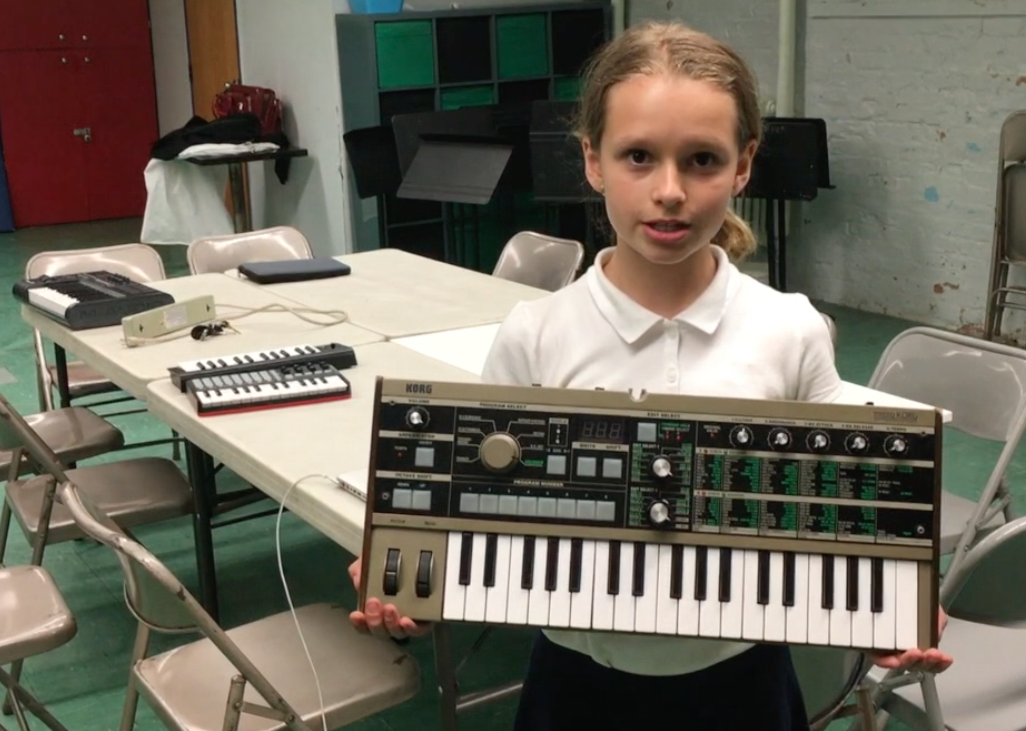
Blackballing electronic music could mean its salvation.
This is a-still evolving, multifaceted art form, with millions or even billions of followers.
Now is the time for electronic music to be taken back to its birthplace—the classroom.
Subscribe to:
Comments (Atom)